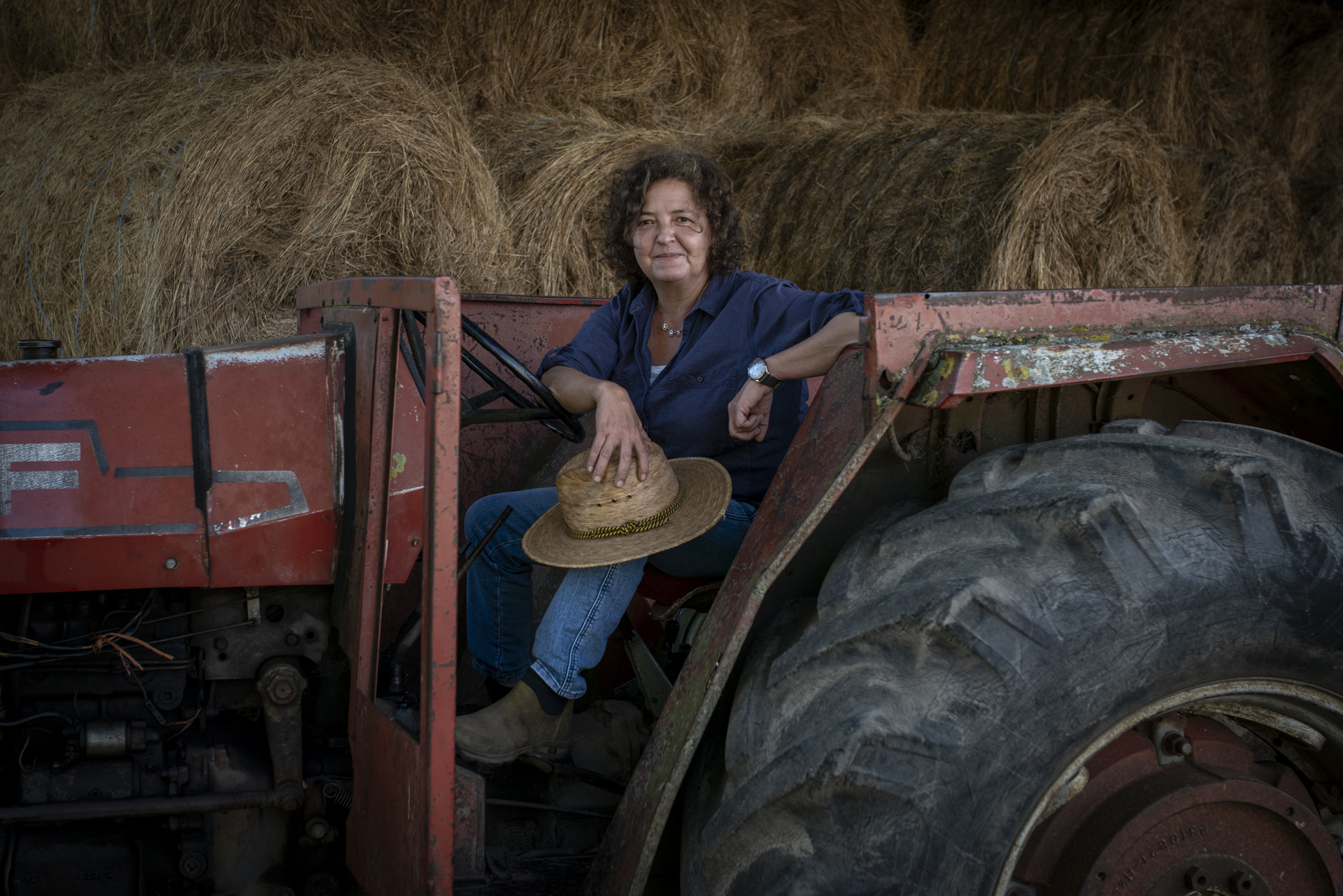
When Marta Álvarez Quintero (Vigo, 1971) took over her father’s farm in Cumbraos (Monterroso, Lugo), it rained for seven months straight. She knew nothing about farming, had never lived in a village and was recovering from heartbreak: her relationship with the woman she had moved to A Ulloa for had come to an end. The daughter of photographer Mary Quintero and José Álvarez, “one of the first farm owners in Galicia”, as she explains, Marta had a decision to make. And she chose to stay on the farm.
Twenty-six years after that decision, Álvarez Quintero owns Granxa Maruxa and is one of the people behind the creation — and success — of the Agrocuir festival, an event that brings together hundreds of people every summer who believe in community, activism, identity and kisses celebrating love in all its diversity. There, in the heart of A Ulloa, Marta shares village life with local residents and festivalgoers in a community committed to defending its land which, against all odds, has not lost any inhabitants throughout these years. It was there that she fell in love again. And it is there that she continues to defend the land and fight against Altri.
How did a woman from Vigo end up running a farm in a village in Monterroso?
My father founded the farm many years ago, but there came a point when my mother said to him: “Look, Pepiño, it’s either the farm or me.” And he went with her. When the tenant farmers who had spent their whole lives here retired, we started renting out the farm. Then, as the lease of our last tenants was coming to an end, I was madly in love with a young woman who lived here in Monterroso, so I decided to take over the farm when the lease expired. I already had the land and, although the facilities were very outdated, that was a very important starting point.
What was your family’s relationship with rural life?
My father was the only one who had anything to do with farming. He was a real pioneer, one of the first farm owners in Galicia. In 1978, his was the fourth farm of its kind in the region. He started importing cows from the Netherlands, which arrived at the port of Vigo. It was revolutionary: the first silo in the area was built here, as was the first refrigerated milk tank. The swimming pool we have on the farm is actually an irrigation reservoir built 50 years ago because my father said Galicia would eventually face water shortages. He has always been an incredibly important role model for me, as has my mother. I made the decision without knowing the first thing about agriculture or livestock farming. My heart was simply here. That young woman and I broke up two months before I officially started running the farm, but that was fine too: it was a learning experience. I had made a decision and chose to see it through.
How do you make the decision not just to live in the countryside, but to start a business there?
In my case, I think I was lucky enough to have always followed my heart. I wanted to live here and I had the opportunity. I was eager to do things and learn, and everything gradually fell into place. I was amazed by everything the cows taught me, by rural life and by what I call “village mode”: you sow a meadow and have to wait for the grass to grow, but that depends on the weather; you inseminate a cow and wait for months, but sometimes there are miscarriages. You never know what will happen, and you have to adapt. Learning to adapt has been one of the most important lessons of my life.
“I was amazed by everything the cows taught me, by rural life and by what I call ‘village mode’. Learning to adapt has been one of the most important lessons of my life”
What were your early days on the farm like?
When I started, on 1 September 2000, the first thing I thought was that I would never date anyone again. I realised everything was in quite a state, that I wouldn’t have any free time and that I couldn’t afford to have many people working with me. Dairy farming is an everyday job: there are no Sundays off, no New Year’s Day, no birthdays. You have to milk the cows twice a day. But I took it in good humour rather than fighting against it. Over time, I began making the farm a little more aesthetically pleasing. I felt I should do what my mother had done with photography: the entire house is painted by Paula Fraile, and I always try to incorporate artistic elements. There is an oak grove at the entrance to the farm, and I am dedicating each tree to an inspiring woman from the A Ulloa region as a tribute. The fight against the Altri project is also very much present.
You used to live in Vigo and now you live in Cumbraos. What do you value most about rural life, and what widespread stereotypes do you think exist?
I think many of those stereotypes are completely wrong. At the end of the day, people in rural communities are far more open-minded than you might imagine. Life here is much more intergenerational: we have seven bars, two bookshops and little else, so whenever there is an event or a concert, we all get together, and that is enriching. We learn as much from children as we do from older people. That said, when I started on the farm, there were comments in the village such as, “That girl from a well-off family, with a university degree, won’t last five minutes on the farm.” People were even placing bets, because nobody wanted to come and work with me. And they had a point, because I knew absolutely nothing (laughs).
But you can learn, can’t you?
Of course you can learn, just as I learned from the cows and from perseverance: the year I started on the farm, it rained for seven months straight. My father taught me an enormous amount, even though he was already getting older, but there was also a wonderful man called Daniel Currás, who died a few years ago. He was a truly kind soul. I started work on a Sunday and managed to persuade him to come with me the previous Saturday. I think he took one look at me and thought, “This girl is getting herself into a real mess…” (laughs).
Villages are often seen as less diverse, less open-minded and more conservative. What do you think about that?
I don’t share that impression. At first, I was the one who closed myself off. I arrived from Vigo with my guard up. I had come out at a very young age with my family’s full support, and I arrived here wondering how people would accept me. What I actually found was tremendous support from the entire village, and I thought, “Maybe you’re the one who’s being more closed-minded.” What I feel, and I genuinely mean this, is affection and kindness from everyone. I’m sure I have a few detractors, but I certainly don’t notice them. When we started organising Agrocuir, I thought some people might disapprove, but when I appeared holding hands with a girl, they would give me an approving wink.
“I had come out at a very young age and arrived with my guard up. When I got here, I found tremendous support from the entire village and thought: ‘Maybe you’re the one who’s more closed-minded’”
You were there at the beginning of Agrocuir, as one of its driving forces.
The person who really started it all was Braulio Vilariño, with an initiative in Palas de Rei called Orgullo Mohicano. I organised a festival on my farm called Monterrosón. Braulio came along with Davide Salvado and Adrián Gallero, and they said they wanted to organise a festival in Palas called Agrogai. But when they arrived at the farm, they realised this was the perfect place: I’m a lesbian, I have a dairy farm and I make my living from the countryside. The way Agrocuir came into being was beautiful. There was so much authenticity in every part of it.
Agrocuir has become a major LBTIQ+ reference point, and similar festivals have emerged elsewhere in Spain. You want to avoid becoming a huge festival. Why?
Because this is a celebration of rural life, of being diverse, of sharing our experiences and of defending the place where we live, which is incredibly important. Agrocuir is not just a festival celebrating sexual diversity; it is also about defending the land and sustainability. That is incompatible with a huge festival that generates masses of waste. Agrocuir has always been a daytime festival so that people can enjoy a traditional village gathering, talk and meet one another. We don’t charge admission; this isn’t some kind of ghetto. It’s about making diversity a natural part of life in nature, in the village, and sharing our experiences without overcrowding.
“Agrocuir is not just a festival celebrating sexual diversity; it is also about defending the land and sustainability”
How has the festival grown over time?
We like to think of growth in terms of creating similar festivals elsewhere. We ran a workshop called “Bring an Agrocuir to Every Village” because, seeing how much good it has done in A Ulloa, we believe it should remain something small that becomes woven into the fabric of each place, allowing diversity to flourish. The openness of the region has been incredible. Many people have come out thanks to this normalisation. I remember that during the festival’s first year, a young man came up to thank me. He told me that his brother had just come out and that their parents thought their son was the only person in the world who was attracted to men. They came to Monterroso that weekend and, seeing such a diversity of men and women kissing, helped them see and accept that we are all equal.
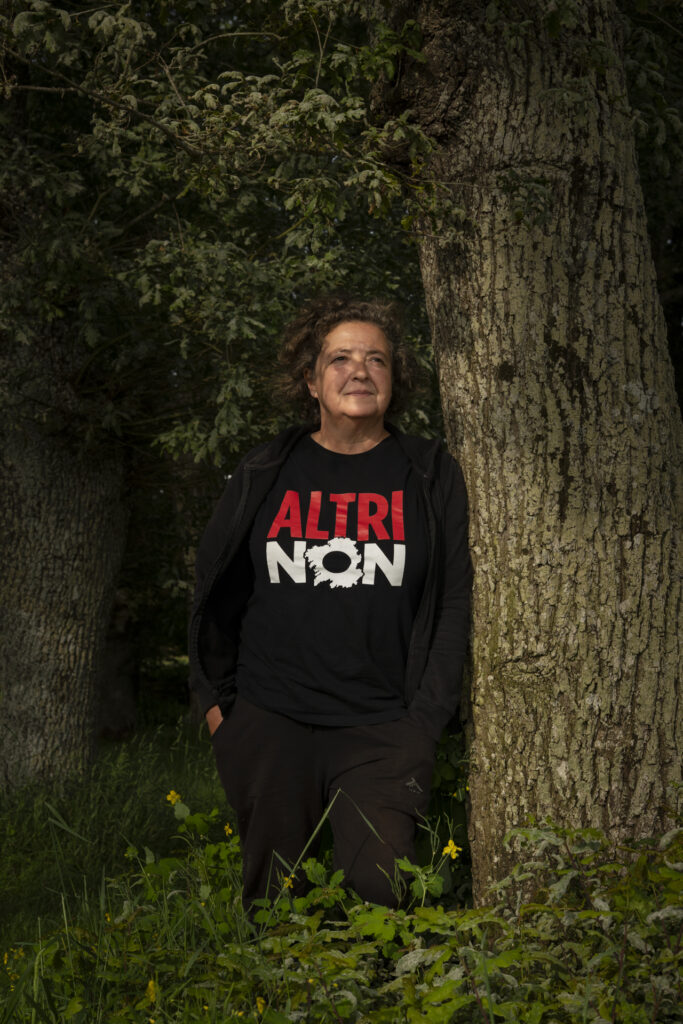
Agrocuir, like the people of the region, has also played an important role in the fight against the Altri project in A Ulloa. It seems the project has finally been shelved.
Yes, it has, but we can’t claim victory just yet, because if the national government changes, things could change too. We’re still here, continuing the fight.
In these struggles, does rural life have a sense of collective spirit and community that cities tend to lack?
Absolutely. I’m completely convinced of it. In the village, everyone works on their own land and on other people’s land whenever help is needed with the harvest. In the past, people would go to the mill together to grind grain… That culture of community, which has always existed, is still very much alive today. I have friends who live in apartment blocks in Vigo with 200 residents and don’t know who else lives there. In my experience of rural life, you know exactly who your neighbours are. There will always be exceptions, of course, but generally speaking, if you need help, you’ll always find four people ready to lend a hand.
“We can’t claim victory over Altri just yet, because if the national Government changes, things could change too. We’re still here, continuing the fight”
Contrary to the general trend in rural Galicia, neither the village nor the parish of Cumbraos has lost population in 26 years. Why do you think that is?
Agrocuir is encouraging people who initially come as festivalgoers — as happened with several friends of Adrián Gallero — to settle here. Every year, new people arrive. There are people from Toledo, Santander, Madrid, Barcelona and Seville who buy houses, speak Galician, dance the muiñeira and play the tambourine better than many Galicians. The level of integration is impressive. There is something captivating about A Ulloa, and it is being repopulated by people who are incredibly interesting from a cultural perspective. Take Ralf Jürgens, for example, who founded Casa Do Picho. He worked in human rights in 83 countries and decided to settle here and establish an artists’ residency. These are very hopeful developments. And not just in terms of productivity, but also culture. It’s about inhabiting the land and learning from it.