

ANTÍA PAZ
Text

BRAIS LORENZO
Photo
How much does it cost to live in a village? The answer is not simply a matter of housing prices. To find out, we compared four rural mountain municipalities among those most affected by depopulation — Chandrexa de Queixa, A Veiga, Folgoso do Courel and Negueira de Muñiz — with Vigo, A Coruña and Santiago de Compostela.
The comparison reveals a more complex reality: in some of the rural municipalities studied, reference prices for both buying and renting are lower, but so are incomes, while the cost of travel is higher. Mobility carries a greater financial burden when public transport connections are scarce or operate according to timetables and demand-responsive services.
Housing: villages without a clear price tag
In the three cities included in the comparison, the average rent recorded by the Instituto Galego de Vivenda e Solo (IGVS) in 2025 was €697.5 per month in Vigo, €731 in A Coruña and €656.9 in Santiago. In municipalities with fewer than 5,000 inhabitants, it was roughly half that amount: the average rent recorded through deposits lodged as of December 2025 was €383.5 per month in the province of Ourense and €347.2 in Lugo.
On paper, this represents significant savings. However, these figures are provincial benchmarks for all municipalities with fewer than 5,000 inhabitants, rather than specific prices for villages such as Chandrexa, A Veiga, Folgoso or Negueira.
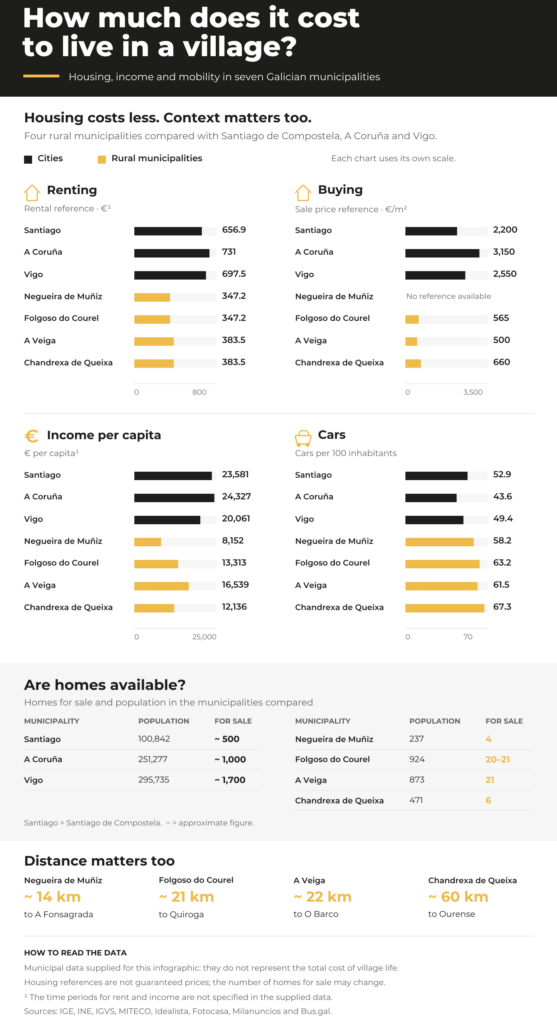
The same difference is broadly reflected in purchase prices. In September 2026, the indicative price of housing stood at around €2,100–€2,300 per square metre in Santiago, around €3,150 in A Coruña and €2,500–€2,600 in Vigo. In the rural municipalities studied, reference prices fell to approximately €500 per square metre in A Veiga, €565 in Folgoso do Courel and €660 in Chandrexa de Queixa. In Negueira de Muñiz, the market is so small and heterogeneous that a single price per square metre would be of limited representative value.
But another important difference emerges here: buying a cheaper house does not necessarily mean having more properties to choose from. In September 2026, there were around 1,700 homes for sale in Vigo, close to 1,000 in A Coruña and around 500 in Santiago. In the mountain municipalities, the scale is entirely different: around 21 homes in A Veiga, between 20 and 21 in Folgoso, six in Chandrexa and just four in Negueira.
The rural housing supply is also highly heterogeneous. Alongside renovated homes, there are old houses requiring major refurbishment, large properties and buildings intended for uses that are not equivalent to those of an urban home.
Statistical data do not make it possible to determine how much housing is actually available in Galician villages. Spot checks of property portals point to very small and irregular markets: the search carried out on some of the most widely used websites found no ordinary long-term rental listings in Folgoso do Courel, while the listings recorded in Chandrexa were seasonal rather than intended as permanent homes. In any case, this is a snapshot of the supply at a particular point in time, not a measure of the annual market.
A clearer example of housing being used for seasonal or tourism-related purposes can be found in the municipalities of the Ribeira Sacra (a candidate for UNESCO heritage recognition for years), where, according to official figures, the services sector linked to tourism, hospitality and accommodation has grown considerably in recent years.
At present, however, it is not easy to find data that would make it possible to measure whether there is indeed a widespread trend towards using homes in Galician villages for temporary rather than residential purposes.
Mobility: fewer public services, more cars per resident
Data from the Instituto Galego de Estatística (IGE) show that the four rural municipalities studied have more passenger cars per resident than Vigo, Santiago or A Coruña. Chandrexa de Queixa reaches 67.3 cars per 100 inhabitants; Folgoso do Courel, 63.2; A Veiga, 61.5; and Negueira de Muñiz, 58.2. In the cities, the rate falls to 52.9 in Santiago, 49.4 in Vigo and 43.6 in A Coruña (vehicle figures correspond to the latest year available in the IGE municipal profile).
The difference alone does not allow us to conclude that a car is essential for the entire rural population. It does, nevertheless, suggest that the more dispersed the population and the more limited the connections, the greater the role private vehicles may play in everyday journeys to access services and meet the basic needs of a predominantly ageing rural population.
The fuel bill
Distance becomes a directly quantifiable expense when using the reference provided by Spain’s Ministry for the Ecological Transition and the Demographic Challenge (MITECO). In the update published on 23 September 2026, the indicative cost was €9.82 per 100 kilometres for 95-octane petrol and €8.20 for diesel.
This means that 100 kilometres cost approximately €9.82 in a petrol vehicle and €8.20 in a diesel vehicle. Ten kilometres amount to €0.98 and €0.82 respectively.
On a 120-kilometre round trip, such as a journey a person from Chandrexa might make to Ourense, fuel costs approximately €11.78 in a petrol car or €9.84 in a diesel vehicle. If that journey is made once a week throughout the year, the annual cost is around €613 in petrol or €512 in diesel.
For a 44-kilometre journey, such as the trip from A Veiga to O Barco, the figure falls to around €225 a year in petrol or €188 in diesel. Between Folgoso and Quiroga, around €214 or €179; and between Negueira and A Fonsagrada, around €143 or €119.
Is public transport a real alternative?
Public transport is available in all four municipalities studied, but it does not operate as a high-frequency urban network. Services and timetables vary from one municipality to another and, in some cases, connections are designed to cater for specific journeys rather than provide flexible mobility throughout the day.
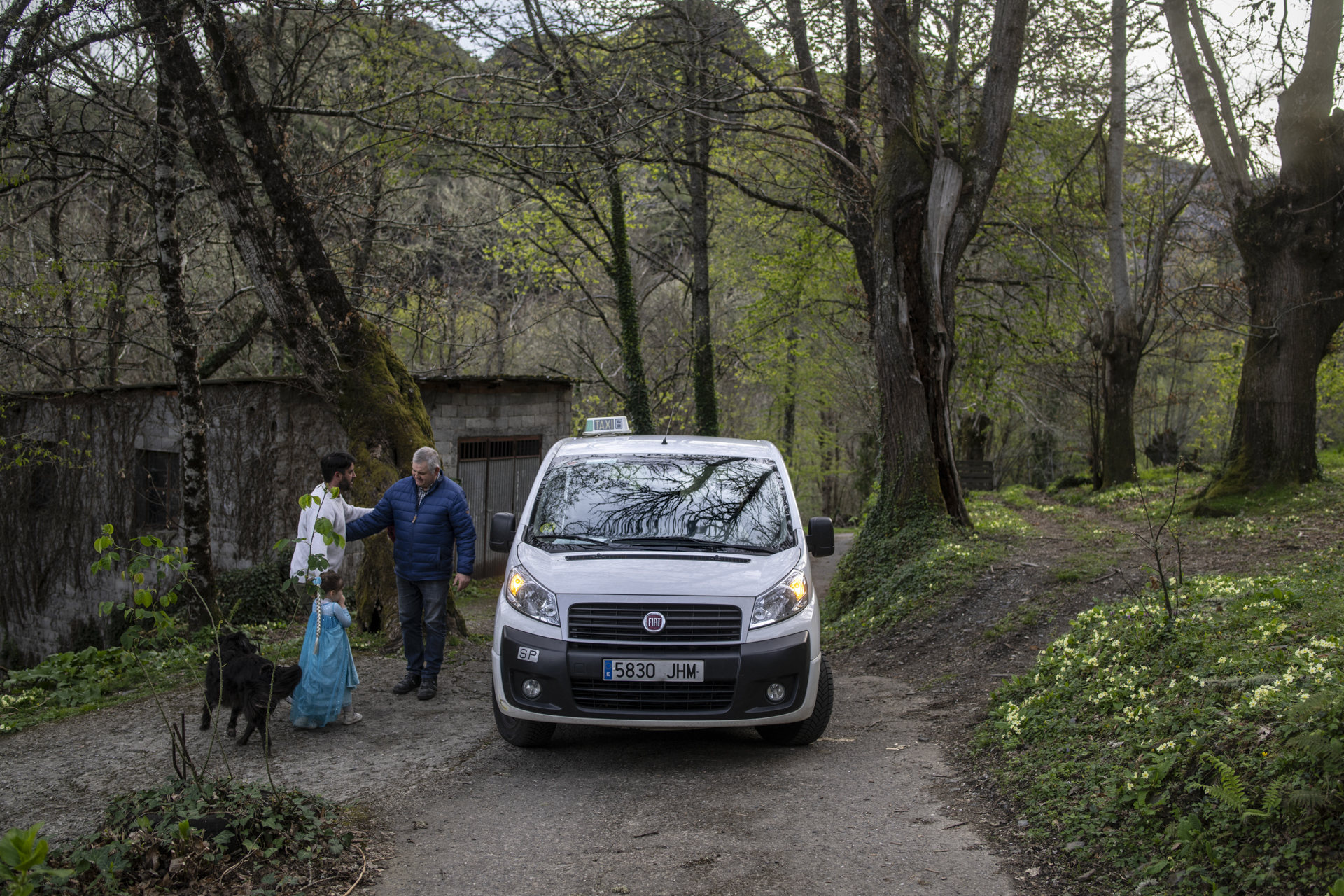
In A Veiga, by contrast, there is a regular connection with O Barco de Valdeorras, although it is limited to two departures a day from Monday to Friday, excluding public holidays. The service operates throughout the year, but some stops and services operate on demand.
In Folgoso do Courel, the connection with Quiroga also operates on demand. The route linking Seoane do Courel with the town has one morning service and one return service in the afternoon, linked to the market-day service in Quiroga. It provides a connection to the neighbouring municipality, but at a frequency far removed from that of an urban transport network.
Something similar happens in Negueira de Muñiz, where the bus to A Fonsagrada operates on demand, with connections concentrated in one outbound service in the morning and one return service at midday, also linked to market day.
There is a bus, then, but not urban-level frequency. And when the timetable does not allow someone to fit a bus journey around a medical appointment, a working day or an errand that cannot wait until the particular day on which the service runs, the alternative is the private car.
The result: distance comes with a bill tool
In these areas, distance from healthcare services adds another layer to the problem. Living in a village in Chandrexa can mean travelling approximately 60 kilometres each way to reach the reference hospital in Ourense. The existence of district hospitals in different parts of Galicia was precisely a response to the need to bring specialist healthcare closer to areas far from the major cities.
Today, the defence of locally accessible healthcare continues to drive social mobilisation in counties such as Valdeorras and Monterrei, where residents have called in recent years for the maintenance or restoration of services at their hospitals.
The Galician Health Service (Sergas) currently operates public hospitals in Ourense, Verín and Valdeorras within the Ourense health area, and public hospitals in Lugo, Monforte and A Mariña within the Lugo health area.
The result is that distance cannot be measured solely in kilometres. It is also measured in time, fuel and the ability to organise everyday life around services that are not always available within the municipality itself.
CASE STUDIES · DATA BY DATA
- CHANDREXA DE QUEIXA (OURENSE)
Population: 471 inhabitants (2025) | 15 under the age of 15 | 228 over the age of 65 | Average age: 63.7 years | Area: 171.8 km².
Gross disposable income: €12,136 per inhabitant (2023).
Housing: €383.5/month (provincial rental benchmark for municipalities with fewer than 5,000 inhabitants) and approx. €660/m² for 6 homes for sale.
Passenger cars: 317 cars (67.3 per 100 inhabitants).
Public transport: demand-responsive service connecting the municipality with Montederramo and A Pobra de Trives. One weekly round trip by private car to Ourense (approx. 120 km) costs around €613 a year in fuel alone.
THE FIGURE: 471 inhabitants · €12,136 income/inhabitant · 67.3 cars/100 inhabitants · €383.5 rental benchmark · €660/m² sales benchmark · 6 homes for sale · approx. 60 km to Ourense
- A VEIGA (OURENSE)
Population: 873 inhabitants (2025) | 43 under the age of 15 | 380 over the age of 65 | Average age: 58.3 years.
Gross disposable income: €16,539 per inhabitant (2023).
Housing: €383.5/month (provincial rental benchmark for municipalities with fewer than 5,000 inhabitants) and approx. €500/m² for 21 homes for sale.
Passenger cars: 537 cars (61.5 per 100 inhabitants).
Public transport: regular service to O Barco de Valdeorras, with two departures a day from Monday to Friday, excluding public holidays. One weekly round trip by car to O Barco (approx. 44 km) costs around €225 a year in petrol.
THE FIGURE: 873 inhabitants · €16,539 income/inhabitant · 61.5 cars/100 inhabitants · €383.5 rental benchmark · €500/m² sales benchmark · 21 homes for sale · approx. 22 km to O Barco
- FOLGOSO DO COUREL (LUGO)
Population: 924 inhabitants (2025) | 36 under the age of 15 | 405 over the age of 65 | Average age: 59.3 years.
Gross disposable income: €13,313 per inhabitant (2023).
Housing: €347.2/month (provincial rental benchmark for municipalities with fewer than 5,000 inhabitants, the lowest of the four provinces) and €565/m² for 20–21 homes for sale.
Passenger cars: 584 cars (63.2 per 100 inhabitants).
Public transport: demand-responsive connection with Quiroga. One weekly round trip by car to Quiroga (approx. 42 km) costs around €214 a year in fuel.
THE FIGURE: 924 inhabitants · €13,313 income/inhabitant · 63.2 cars/100 inhabitants · €347.2 rental benchmark · €565/m² sales benchmark · 20–21 homes for sale · approx. 21 km to Quiroga
- NEGUEIRA DE MUÑIZ (LUGO)
Population: 237 inhabitants (2025) | 25 under the age of 15 | 67 over the age of 65 | Average age: 50.2 years.
Gross disposable income: €8,152 per inhabitant (2023), the lowest of the seven municipalities analysed.
Housing: €347.2/month (provincial rental benchmark for municipalities with fewer than 5,000 inhabitants), while it is impossible to establish a sale price per square metre because there are only 4 homes on the purchase market.
Passenger cars: 138 cars (58.2 per 100 inhabitants).
Public transport: demand-responsive service to A Fonsagrada, with one outbound and one return service according to the published timetable. One weekly round trip by car to A Fonsagrada (approx. 28 km) costs around €143 a year in petrol.
THE FIGURE: 237 inhabitants · €8,152 income/inhabitant · 58.2 cars/100 inhabitants · €347.2 rental benchmark · sales benchmark in €/m² impossible to determine · 4 homes for sale · approx. 14 km to A Fonsagrada
- VIGO (PONTEVEDRA)
- Population: 295,735 inhabitants (2025) | Average age: 47.2 years.
- Gross disposable income: €20,061 per inhabitant (2023).
- Housing: average rent of €697.5/month in 2025 and €2,550/m² for approx. 1,700 homes for sale.
- Passenger cars: 49.4 per 100 inhabitants.
THE FIGURE: 295,735 inhabitants · 49.4 cars/100 inhabitants · €697.5 rental benchmark · €2,550/m² sales benchmark · approx. 1,700 homes for sale · €20,061 income/inhabitant
- Population: 295,735 inhabitants (2025) | Average age: 47.2 years.
- A CORUÑA
Population: 251,277 inhabitants (2025) | Average age: 47.6 years.
Gross disposable income: €24,327 per inhabitant (2023).
Housing: average rent of €731/month in 2025 and €3,150/m² for around 1,000 homes for sale.
Passenger cars: 43.6 per 100 inhabitants.
THE FIGURE: 251,277 inhabitants · 43.6 cars/100 inhabitants · €731 rental benchmark · €3,150/m² sales benchmark · approx. 1,000 homes for sale · €24,327 income/inhabitant
- SANTIAGO DE COMPOSTELA
Population: 100,842 inhabitants (2025) | Average age: 46.6 years.
Gross disposable income: €23,581 per inhabitant (2023).
Housing: average rent of €656.9/month in 2025 and €2,200/m² for around 500 homes for sale.
Passenger cars: 52.9 per 100 inhabitants.
THE FIGURE: 100,842 inhabitants · 52.9 cars/100 inhabitants · €656.9 rental benchmark · €2,200/m² sales benchmark · approx. 500 homes for sale · €23,581 income/inhabitant
Conclusion (I)
How much does it cost to live in a village? The answer is not simply “less”. Housing has lower reference prices in small municipalities, both for renting and buying, but incomes are also lower. The residential supply is more limited, and mobility can carry a greater financial burden when the public transport network offers few routes or operates on demand.
Distance can become a recurring cost. One weekly car journey between Chandrexa and Ourense amounts to around €613 a year in petrol alone, or €512 in diesel; between A Veiga and O Barco, around €225 or €188; between Folgoso and Quiroga, around €214 or €179; and between Negueira and A Fonsagrada, around €143 or €119.
Buying is different too. In Vigo, hundreds of homes can be found to choose from; in Chandrexa, barely six. In Negueira, four.
Living somewhere is not simply about paying for a roof over your head. It also means bearing the cost of travelling for certain errands, shopping, medical appointments or administrative procedures. That is one of the costs of low population density: the price of being able to move around because of the free choice — or lack of it — of where we want to live.